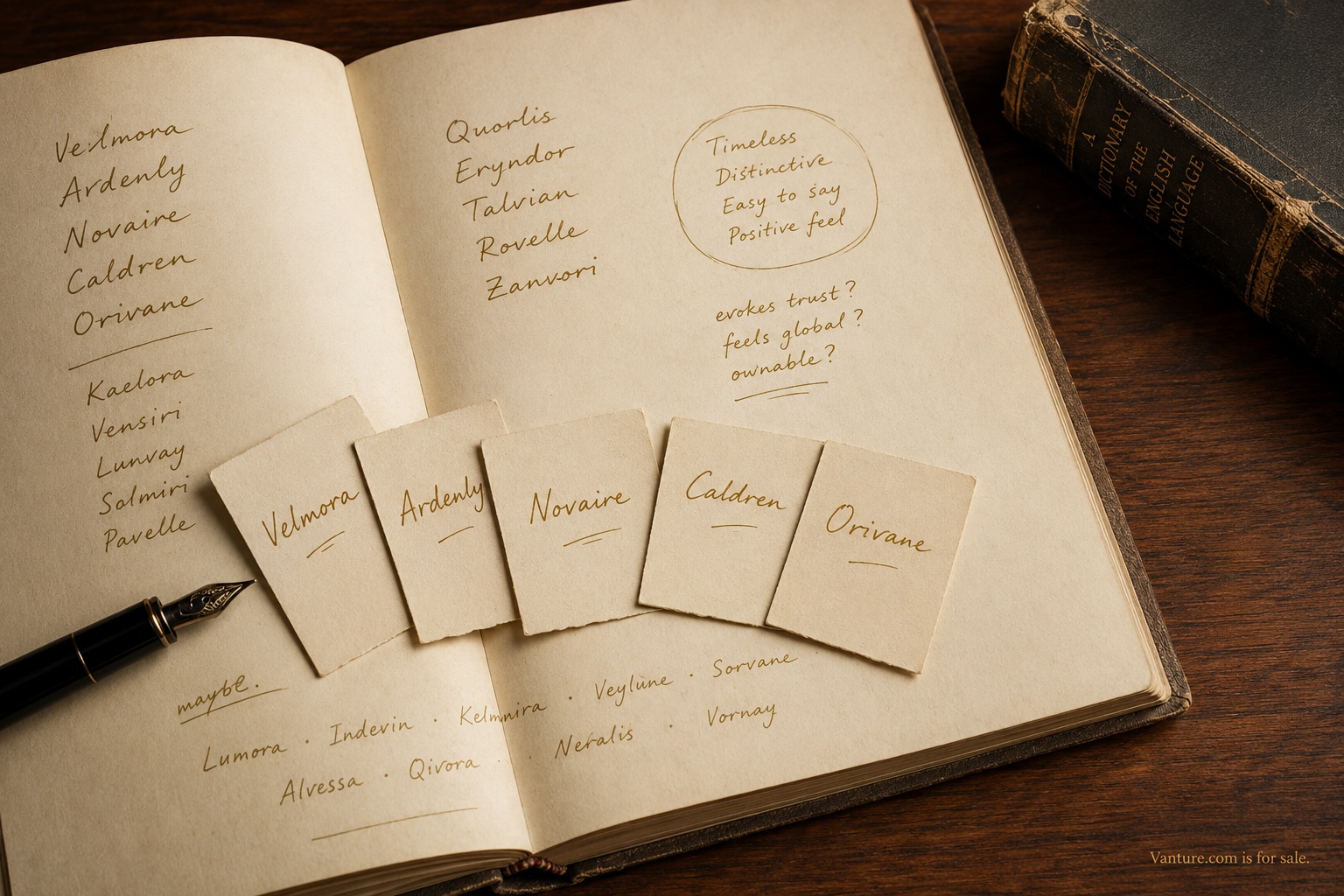
A clear name is not necessarily a literal name. This distinction matters because founders are often told to make the company’s activity obvious in the first two seconds. The advice sounds sensible, especially when a business is new and attention is scarce. Yet a name that summarizes the first product can become inaccurate as soon as the company learns. Clarity lives elsewhere. A clear name is one a person can hear, say, spell, and carry into another conversation. It gives the business a stable handle while the explanation around it becomes more precise. The name does not have to perform the pitch, the positioning, and the product tour all at once. It has to make those things easier to remember.
I test that kind of clarity in ordinary situations. Imagine introducing the company at a noisy dinner, leaving its name in a voicemail, printing it in small type on a proposal, or asking someone to visit the website without sending a link. Does the listener need a spelling lesson? Does the speaker apologize before saying it? Does the word vanish among five competitors that use the same category terms? These moments are less glamorous than a naming workshop, but they are where a name earns its keep. A company can overcome some friction with enough money and repetition. A young business rarely has either to spare. It should not volunteer for confusion that can be seen before launch.
Literal names do offer an immediate clue. A phrase such as North Street Accounting tells a local customer something useful. If the ambition is a stable practice in one place, that may be an excellent choice. Trouble begins when founders use literalness as a substitute for a decision about scope. They stack a geography, a category, and a service into a name because each word feels safe. The result is accurate but hard to distinguish, and any later move beyond that geography or service looks like a contradiction. The right question is not whether descriptive names are good or bad. It is whether this description will remain helpful for the life the owner actually wants the business to have.
An invented name creates a different bargain. It begins without a dictionary definition attached to the company, so the business must supply context. That costs effort. The homepage, product language, visual identity, and first customer conversations have to answer what the company does. In return, the name can hold meaning that competitors do not automatically share. Every good experience points back to one mark. As the offer expands, the mark remains true because it was never a narrow claim about a feature. This is why invented names can feel empty in a list yet strong in use. They are containers, and the quality of the company determines what accumulates inside them.
Sound is part of the calculation. A name does not need to be musical, but it should have a shape people can grasp. Familiar letter patterns help. So does a stress pattern that feels natural in the language of the main market. Unusual spelling can create distinction, but each surprise imposes a small tax on recall. One surprise may be worth it; three usually are not. I like to ask several people to write a candidate after hearing it once, then ask a different group to say it after reading it. The exercise is crude and valuable. It reveals where the name asks for explanation before any logo or campaign can disguise the problem.
Meaning deserves the same practical treatment. Founders often search for a word that communicates every value they hold: trust, speed, warmth, intelligence, courage, craft, and global ambition. No compact name can carry that load honestly. Better to choose the few associations that matter and leave room for the company to behave its way into the rest. A harder consonant may make a word feel technical; an open ending may make it feel expansive. Existing roots can lend familiarity. But these are tendencies, not scientific guarantees. Context changes them. The same name can feel serious on an investment letter and playful on a box of sweets. Design and conduct finish what the sound begins.
Legal and digital availability must enter the process before anyone falls in love. Trademark review is professional work, not a quick search for an exact match. A candidate can face problems from similar names in related classes even when the precise word appears free. Domains and social handles create another layer. I prefer to know the cleanest viable address early, because the address will be said, printed, and trusted alongside the name. A modified domain is not always fatal, but the team should understand the future cost of teaching that modifier. Clearance is not the exciting part of naming. It is the part that keeps excitement from becoming an expensive retreat.
The final test is whether the organization can inhabit the name without constantly explaining why it chose it. An elaborate origin story is useful only if customers find it interesting. Most do not. They care whether the company solves a problem, keeps a promise, or makes something worth returning to. A clear name makes that experience easy to attribute and retrieve. It survives changes in the tagline. It looks natural in a sentence employees can say without irony. It can sign a contract, answer a phone, mark a package, and name a place. That is enough work for two or three syllables. The company should take responsibility for the rest.
A useful decision meeting should end with evidence rather than adjectives. Put the finalists on a one-page scorecard covering spoken recall, spelling, distinction in the category, future range, domain fit, and clearance status. Weight the criteria before scoring so a late burst of enthusiasm cannot rewrite the rules. Then give the leading candidate a short period in realistic use. Draft an invoice, a job post, a customer email, a press sentence, and the opening of the website. This rehearsal exposes awkwardness that a presentation slide conceals. It also helps the team stop debating what a name “feels like” in isolation and judge how it performs as part of an actual company.
Once the choice is made, document its ordinary form. Decide capitalization, pronunciation, possessive use, and the one sentence that explains the company beside it. Register the relevant domains and accounts, begin professional clearance, and give employees a simple answer when someone asks about the name. Do not burden that answer with invented mythology. Consistent use is more persuasive. The first months should make the company easier to understand each time the name appears. That is how a coined word moves from unfamiliar to obvious: not through a launch video that insists it is meaningful, but through repeated encounters in which the business is clear, useful, and recognizably itself.